Internships are getting a bit of a bad press at the moment, and there are a lot of horror stories about year abroad students in particular being majorly exploited for little or no money. Even among my friends I've heard of people being forced to do overtime or run personal errands for lazy bosses on a power trip, and it's so so unfair, and makes me realise how lucky I've been with my placements.
The worst thing is that it is just luck - most people sort out their internships way before the start of the year, with the overseas aspect preventing them from meeting their boss or being able to go in and get a feel for the office environment. So in defence of the humble internship, here's a summary of what I've done and learned over the year.
Both of my internships in Italy were unpaid, but luckily between the Erasmus grant and Student Finance there wasn't a financial issue, and I was happy just to have found placements in the industries I was most interested in, particularly my one in Rome, which was working as a reporter for an online newspaper and so was basically exactly what I wanted to do. I became well-versed on gross Italian foods, radioactive boars, the ever-amazing Pope, Berlusconi's dog, the hottest Italian athletes and best Italian chat-up lines - some personal hightlights among the 100 or so articles I got to write, but it was just really fun being part of the small team and hunting out Italy's best news stories, as well as sourcing interviews and features.
Alongside my Rome internship, I was offered some paid work writing freelance articles for a local magazine, which was great I think may even have been my first time ever getting paid for writing. My first article involved scouting out Rome's top brunch spots (where I got to sample their wares for free) and the second was a round-up of cultural events going on in the city, for which I got free tickets to an international dance festival. From meeting other foreign journalists through my placement, I had quickly learnt the value of a well-timed, shameless 'profession drop', if that's a thing - it's amazing how quickly a hefty brunch bill can transform into a stack of complimentary pancakes once you whack out the 'did I mention I'm a journalist' card (seems to work regardless of whether you're actually in the food reviewing business). I'm also not quite sure why journalism seems to involve so much brunch, but who's complaining?
So one of the main attractions of my Berlin placement, in PR, was finally getting my first ever proper wage, something which is depressingly absent from journo internships in most countries, but having worked here for a while now, it's also been interesting to see what goes on in the other side of the industry.
I'm working for a digital agency, or an 'ideas and innovation agency' as it enigmatically refers to itself. Although the Berlin office has only been open for a couple of years, it's already won several awards, and worldwide the company has the impressive accolade of being the most awarded ad agency, so it was quite daunting to turn up with embarrassingly little knowledge of the digital world. I mean, I know my way around Facebook, 4od and the part of YouTube with all the Let It Go covers as well as anyone, but know nothing about the behind-the-scenes coding and binary(?) stuff. As I'm interning with the company's PR Director, I'm not involved in any of the actual projects - which is just as well, as they're all incredibly techy, with everyone's desks crammed with a suitably intimidating number of screens, all spouting lines of code or fancy graphs - but my job is to help with promoting the projects and the agency in general.
This has involved helping people in the company prepare for press interviews, helping with visits and talks at the office for design students, writing and translating press releases about the agency, and helping plan and organise events, working on everything from finding a candyfloss machine rental with the option of orange coloured candyfloss (surprisingly difficult) to marketing the event across social media to creating name badges for guests. My boss has created a strong contender for the world's most detailed spreadsheet, which has every single task necessary for the event, down to things like 'make sure curtains are drawn' and 'make back-ups of the back-up copy of the guestlist. It's a step up from the Tesco Value vodka runs and brainstorming a bizarre costume theme which were the cornerstones of our Entz event planning at uni.
Then there's internal communication, which accounts for a surprising amount of the PR role. In a huge company with over 1,500 employees worldwide, the bosses try to make sure everyone stays up to date on what the other offices have been working on, so there's an internal newsletter each week which I've been helping put together (favourite task being the interviews for the weekly employee profiles, in particular the revelation from one of the managers that she knows how to milk a cow). And within the Berlin office, I'm in charge of sending out a daily press review, which involves reading all the day's tech and digital news and sending out summaries of the major stories, in Germany and worldwide. I have my suspicions as to how much notice anyone takes of this, but if nothing else it's been a handy crash course for me to figure out what the company actually does and what's going on in the industry. It's also taught me loads about things like which jobs are most at risk of being replaced by robots and how hackers can control your home via your toaster and stuff so that's always good to know.
And of course, there's the admin. A lot of my time has been spent putting together and updating various documents; calendars of work and awards across the agency, submissions for newspaper articles, the agency's profile on industry websites, employees' biographies. Generic internship stuff, but it's nice to know that my little bit of research is being used for a pitch, and that my work has helped someone prepare for an interview or something.
Tuesday, 18 March 2014

Thursday, 27 February 2014
Thoughts on Germans and road-crossing
Why did the German cross the road?
If you answered anything other than 'because the green man was showing', you lose.
The Germans seem to share the British ingrained respect for all rules, but none of our reserve. I've been on the receiving end of loud tuts and disapproving head-shakes for crossing the road while the red man was showing - I looked both ways, there were no cars to be seen for miles, and I'm also 80% sure the traffic light was broken, but that wasn't enough to deter my fellow road-crossers from sticking it out.
They're probably still there now, slowly growing weary, tired and cold from standing on the same bit of pavement for over 24 hours, but warmed by the inner satisfaction in knowing that they are following the rules.
I'm all for road safety, but it takes a bit of getting used to after Rome, where every pedestrian crossing felt like the Hunger Games arena - may the odds be ever in your favour indeed - and the green man meant nothing more than 'haha we're still going to drive straight at you, loser'.
It really begs the question of why Khrushchev bothered with the Berlin Wall; in a country whose population can seemingly be kept in one place just by the presence of a luminous red man, it seems he may have missed a trick.
If you answered anything other than 'because the green man was showing', you lose.
The Germans seem to share the British ingrained respect for all rules, but none of our reserve. I've been on the receiving end of loud tuts and disapproving head-shakes for crossing the road while the red man was showing - I looked both ways, there were no cars to be seen for miles, and I'm also 80% sure the traffic light was broken, but that wasn't enough to deter my fellow road-crossers from sticking it out.
They're probably still there now, slowly growing weary, tired and cold from standing on the same bit of pavement for over 24 hours, but warmed by the inner satisfaction in knowing that they are following the rules.
I'm all for road safety, but it takes a bit of getting used to after Rome, where every pedestrian crossing felt like the Hunger Games arena - may the odds be ever in your favour indeed - and the green man meant nothing more than 'haha we're still going to drive straight at you, loser'.
It really begs the question of why Khrushchev bothered with the Berlin Wall; in a country whose population can seemingly be kept in one place just by the presence of a luminous red man, it seems he may have missed a trick.
On another note, German traffic lights
are in themselves pretty great, at least in former East Berlin. For
one thing, the Ampelmännchen ('little traffic light man' - isn't
German just the best) is wearing a bowler hat. When in stern red
mode, he's depicted with arms outstretched, as though physically
obstructing his fellow pedestrians from attempting an unsafe
crossing, something I would not be at all surprised to hear many
Germans actually do, while his green counterpart appears to be
swinging his arms enthusiastically as he strides across the road.
It's one of the few features of the Communist era to have survived
the fall of the Wall and become an integral part of Berlin culture,
and there's even a dedicated Ampelmännchen souvenir shop. Only in
Germany.
Wednesday, 26 February 2014
Getting things done
Since my first week in Berlin, things have been a little less tragic (and a lot less phlegmmy, you'll be pleased to hear) and I think the German productivity might even be rubbing off on me. After six months of Italian shoulder shrugs, 'behhh's and general things not working as they should, it makes a nice change to be in a country where you can actually rely on people and transport schedules. In my last week in Rome it rained, quite a lot even by my Mancunian (or thereabouts) standards, and everything ground to a soggy standstill. The metro went into complete shutdown, shops closed, and I learnt that 'oooh it's a bit wet outside' is a valid reason for Italians to take a day off work. I'd love to see how far that would get them in England.
Anyway, true to stereotype, the Germans get stuff done, and now, somewhat less true to character, so have I.
Probably the biggest achievement was finding a flat within my first two weeks, something I'm still feeling a bit smug about. Having heard several people's tales of the various struggles/despair/scams/compromises/animal sacrifices etc etc (one of those might be made up) they'd had to go through before finding a flat, I really didn't want to get involved in the househunt at all. I hate ringing people up, for one thing. But as it turns out, the prospect of homelessness is a great motivator, so I went to three viewings, and the last one turned into an offer of a flatshare, which is where I'm living now for the next six months. It's a really nice flat in a cool bit of Berlin, shared with a German girl and with special features including a Nespresso machine, toaster and kettle (rare luxuries in these foreign parts), and a massive book on cocktail making which was left in my room. It's also on the fourth floor with no lift, so is basically a flat and a gym in one. Bargain.
During my first weekend, Kate and Claire, two of my friends from college, came to visit Berlin. With local knowledge extending no further than the nearest English speaking doctor, my office and the supermarket, I wasn't able to be a very good tour guide but it was great to see people from back home who are also doing the whole 'live in another country, go on it'll be funny' thing. They're both enjoying their years and seem settled in their countries, which was good to hear as throughout the year it's become obvious that universities don't give any help with the year abroad at all. You are just sort of unceremoniously dumped in a new country and expected to fend for yourself; it can go really well or really horribly badly, and I've heard stories from both sides.
After they left, I went along to a voluntary project I'd heard about. The idea is that a group of volunteers prepare a healthy 3 course meal for local homeless people - actually, anyone can go, but if you can afford it, you're supposed to leave a donation which will cover your meal and that of a homeless person (this is only about €5). There's some live music, this time from an Ethiopian band, and the idea that is that as well as the food, it gives the homeless community some more interaction than just with care workers and so on. I'm completely guilty of ignoring homeless people on the streets, mainly because I don't think giving them money directly is usually the best way to help, but then I feel guilty about seeming rude and ignoring them, so it was nice to be able to get involved in something which has a positive impact. Everyone there was so friendly and I'm hoping to go back each month to help.
After the dinner I also went to a comedy night with some girls I met there. It was 'Deuglish' night, which meant there were 3 comedians from Germany and 3 from England. I'd never seen German comedy before, and it was a bizarre night, but I couldn't say how much of my confusion was down to their odd sense of humour and how much was just my lack of German knowledge.
So it seems that Berlin is much nicer when you're not all fluey and sorry for yourself - who'd have guessed. It's fast becoming my favourite city, even from the little I've seen from it in between my internship, winning major bonus points over Rome for the fact that everything works. More exciting tales soon about the job, the city, and the wonderfully efficient transport network (the latter potentially not so exciting for someone who hasn't spent 6 months in Italy, and 20 years before that in a tiny village, both of which subscribe to the motto of 'you wait ages for a bus, and then none turn up, ever')
Anyway, true to stereotype, the Germans get stuff done, and now, somewhat less true to character, so have I.
Probably the biggest achievement was finding a flat within my first two weeks, something I'm still feeling a bit smug about. Having heard several people's tales of the various struggles/despair/scams/compromises/animal sacrifices etc etc (one of those might be made up) they'd had to go through before finding a flat, I really didn't want to get involved in the househunt at all. I hate ringing people up, for one thing. But as it turns out, the prospect of homelessness is a great motivator, so I went to three viewings, and the last one turned into an offer of a flatshare, which is where I'm living now for the next six months. It's a really nice flat in a cool bit of Berlin, shared with a German girl and with special features including a Nespresso machine, toaster and kettle (rare luxuries in these foreign parts), and a massive book on cocktail making which was left in my room. It's also on the fourth floor with no lift, so is basically a flat and a gym in one. Bargain.
During my first weekend, Kate and Claire, two of my friends from college, came to visit Berlin. With local knowledge extending no further than the nearest English speaking doctor, my office and the supermarket, I wasn't able to be a very good tour guide but it was great to see people from back home who are also doing the whole 'live in another country, go on it'll be funny' thing. They're both enjoying their years and seem settled in their countries, which was good to hear as throughout the year it's become obvious that universities don't give any help with the year abroad at all. You are just sort of unceremoniously dumped in a new country and expected to fend for yourself; it can go really well or really horribly badly, and I've heard stories from both sides.
After they left, I went along to a voluntary project I'd heard about. The idea is that a group of volunteers prepare a healthy 3 course meal for local homeless people - actually, anyone can go, but if you can afford it, you're supposed to leave a donation which will cover your meal and that of a homeless person (this is only about €5). There's some live music, this time from an Ethiopian band, and the idea that is that as well as the food, it gives the homeless community some more interaction than just with care workers and so on. I'm completely guilty of ignoring homeless people on the streets, mainly because I don't think giving them money directly is usually the best way to help, but then I feel guilty about seeming rude and ignoring them, so it was nice to be able to get involved in something which has a positive impact. Everyone there was so friendly and I'm hoping to go back each month to help.
After the dinner I also went to a comedy night with some girls I met there. It was 'Deuglish' night, which meant there were 3 comedians from Germany and 3 from England. I'd never seen German comedy before, and it was a bizarre night, but I couldn't say how much of my confusion was down to their odd sense of humour and how much was just my lack of German knowledge.
So it seems that Berlin is much nicer when you're not all fluey and sorry for yourself - who'd have guessed. It's fast becoming my favourite city, even from the little I've seen from it in between my internship, winning major bonus points over Rome for the fact that everything works. More exciting tales soon about the job, the city, and the wonderfully efficient transport network (the latter potentially not so exciting for someone who hasn't spent 6 months in Italy, and 20 years before that in a tiny village, both of which subscribe to the motto of 'you wait ages for a bus, and then none turn up, ever')
Wednesday, 19 February 2014
I live in Berlin now...
...Just about. In what turned out to be a gross overestimation of my capabilities, when I planned my switch between countries I gave myself a grand total of 64 hours between finishing work in Rome on a Friday afternoon, and turned up to my new job on Monday morning, in Berlin. I'm not quite sure why this seemed like such a fantastic idea, and it is not a tactic I would recommend.
The actual, physical, moving part went surprisingly well, considering I'd inexplicably gained an extra suitcase of luggage during my first five months. No matter; I am by now well practiced in the fine art of standing looking helpless in an airport with my cases, and again once on the plane as I clog up the aisle, too weak to lift my definitely-over-the-permitted-weight hand luggage into the locker and steadfastly ignoring the glares of hatred from other more competent passengers, until some kind stranger takes pity. I even made it to my temporary accommodation relatively unscathed, and used the weekend to embark on my flat hunt. I think some part of me was vaguely expecting that in those vital 64 hours I'd manage to fly to Berlin, find a flat, remember all my German, assimilate perfectly into the new culture and turn up at my new office with time to spare, ready to wow my new boss.
Instead, none of the above happened, and upon arrival at work I spectacularly failed to open the front door, and managed to get stuck in the bike shed where I had to await rescue. In my defence, it is an extremely heavy door, and as previously mentioned, brute strength is far from my forte.
As first impressions go it was fairly tragic, and only got worse, as I went on to spend the rest of the week developing some kind of flu. I really really didn't want to be 'that' intern who took the second day off sick, so took the (in hindsight far worse) option of being the intern who coughed a lot, probably infected half the office and could barely manage simple tasks, before finally conceding and going home on Thursday. Ideal.
Being ill on the year abroad is awful. I don't have any of my Disney DVD's with me, the German orange juice I bought tastes gross, and it came at the absolute worst time because I had just traded lovely Rome, where I had actual friends and an amazing job, for Berlin where I knew nothing and no one, least of all how to get through all the German bureaucracy, which it turns out is not just a cliche but a very real and very horrible deluge of paperwork to fill out, forms to sign, places to go and people to see.
The first step is to 'anmelden', registering as a German citizen, and this is the gateway to all sorts of other exciting treats; a phone contract, bank account, and a tax number. I'm not overly keen about the latter, since about 20% of my hard-earned intern wages will apparently be going to 'obligatory social security contributions', most bizarrely my 'compulsory pension scheme'. But it all has to be done, which means you have to anmelden, and to anmelden you need to have a permanent German address. Which I did not.
Finding accommodation in Berlin is super competitive - to the extreme that interviews, and in some cases 'auditions' or 'castings' are held for potential tenants or housemates. Apparently, you can expect to be quizzed on anything from your cooking skills to music taste to political views, and that's assuming you get a vaguely normal landlord who isn't just getting a kick out of the sudden power they've had thrust upon them and has taken it upon themselves to think up a selection of riddles, role play tasks or incriminating ink-blot tests...
I guess it's fair enough that flatmates get to choose who they's like to live with, but it doesn't bode well when your current defining character traits are near-constant sniffing and nose-blowing, and a voice so croaky it sounds like you've been possessed. I'm also using flu as the reason I've been struggling to make sense in any language, let alone scary German with all its grammar and words and stuff.
The actual, physical, moving part went surprisingly well, considering I'd inexplicably gained an extra suitcase of luggage during my first five months. No matter; I am by now well practiced in the fine art of standing looking helpless in an airport with my cases, and again once on the plane as I clog up the aisle, too weak to lift my definitely-over-the-permitted-weight hand luggage into the locker and steadfastly ignoring the glares of hatred from other more competent passengers, until some kind stranger takes pity. I even made it to my temporary accommodation relatively unscathed, and used the weekend to embark on my flat hunt. I think some part of me was vaguely expecting that in those vital 64 hours I'd manage to fly to Berlin, find a flat, remember all my German, assimilate perfectly into the new culture and turn up at my new office with time to spare, ready to wow my new boss.
Instead, none of the above happened, and upon arrival at work I spectacularly failed to open the front door, and managed to get stuck in the bike shed where I had to await rescue. In my defence, it is an extremely heavy door, and as previously mentioned, brute strength is far from my forte.
As first impressions go it was fairly tragic, and only got worse, as I went on to spend the rest of the week developing some kind of flu. I really really didn't want to be 'that' intern who took the second day off sick, so took the (in hindsight far worse) option of being the intern who coughed a lot, probably infected half the office and could barely manage simple tasks, before finally conceding and going home on Thursday. Ideal.
Being ill on the year abroad is awful. I don't have any of my Disney DVD's with me, the German orange juice I bought tastes gross, and it came at the absolute worst time because I had just traded lovely Rome, where I had actual friends and an amazing job, for Berlin where I knew nothing and no one, least of all how to get through all the German bureaucracy, which it turns out is not just a cliche but a very real and very horrible deluge of paperwork to fill out, forms to sign, places to go and people to see.
The first step is to 'anmelden', registering as a German citizen, and this is the gateway to all sorts of other exciting treats; a phone contract, bank account, and a tax number. I'm not overly keen about the latter, since about 20% of my hard-earned intern wages will apparently be going to 'obligatory social security contributions', most bizarrely my 'compulsory pension scheme'. But it all has to be done, which means you have to anmelden, and to anmelden you need to have a permanent German address. Which I did not.
Finding accommodation in Berlin is super competitive - to the extreme that interviews, and in some cases 'auditions' or 'castings' are held for potential tenants or housemates. Apparently, you can expect to be quizzed on anything from your cooking skills to music taste to political views, and that's assuming you get a vaguely normal landlord who isn't just getting a kick out of the sudden power they've had thrust upon them and has taken it upon themselves to think up a selection of riddles, role play tasks or incriminating ink-blot tests...
I guess it's fair enough that flatmates get to choose who they's like to live with, but it doesn't bode well when your current defining character traits are near-constant sniffing and nose-blowing, and a voice so croaky it sounds like you've been possessed. I'm also using flu as the reason I've been struggling to make sense in any language, let alone scary German with all its grammar and words and stuff.
Sitting wrapped in a Star Wars blanket surrounded
by various cough sweets and dubious herbal remedies (all supplied by my
well-meaning but slightly odd landlady) was not how I imagined my
first week in Berlin, but it can only really get better (please). More, and hopefully less moany, updates to follow soon!
Saturday, 16 November 2013
Stumble Stones: Rome's smallest monuments
Rome is full of huge reminders of the city's ancient past; statues, ruins and buildings all jump out at you, begging to be noticed and admired. But even the quietest streets have stories to tell.
I walk the same route to and from work every day, but it took me two weeks to notice two golden squares among the cobbles of one street. It was raining, so I was keeping my head down, and then I saw them - sort of glinting against a background of grey. So I stopped to look, wondering if they were part of an art installation, or gave information about the building they were placed outside.
The stones are a memorial. They each sum up a life in very few words, haiku-like in their simplicity. 'Here lived Lionello Alatri' reads one; the other is for his wife Evelina. Three dates follow; the date they were born, the date they were deported (to Auschwitz), the date they were murdered.
I walk the same route to and from work every day, but it took me two weeks to notice two golden squares among the cobbles of one street. It was raining, so I was keeping my head down, and then I saw them - sort of glinting against a background of grey. So I stopped to look, wondering if they were part of an art installation, or gave information about the building they were placed outside.
The stones are a memorial. They each sum up a life in very few words, haiku-like in their simplicity. 'Here lived Lionello Alatri' reads one; the other is for his wife Evelina. Three dates follow; the date they were born, the date they were deported (to Auschwitz), the date they were murdered.


I found out later that the stones form just a tiny part of a project spanning eight countries, with over 40,000 stones and 84 in Rome. Each commemorates a Holocaust victim, with a simple inscription on the gold-plated stone outside the person's former home.
The artist behind it, Cologne-born Gunter Demning, wanted to give back a name to the victims who had been reduced to a number, returning them symbolically to the home and neighbourhood that was snatched from them.
They are called Stumbling Stones, Stolpersteine in German, because the idea is that you literally stumble over the slightly raised cobbles, and are forced to remember. Demning says that stooping down to read the details is a kind of bow of respect to the victims.
Today the apartment block where the Alatri's lived is an office building. It's in one of Rome's priciest districts, full of businessmen in suits who seem to be in too much of a rush to notice two golden cobblestones.
I found a website with information about Rome's Holocaust victims, where I found out Lionello had dedicated much of his life working for Jewish institutions, and helped many Jewish refugees who fled to Rome from countries under Nazi control. He also owned a textiles business, but was forced to resign once Italy's racial laws came into force. Shortly afterwards, he and Evelina were taken from their home and deported to Auschwitz. After the week-long journey, they were judged unfit to work on arrival, and were both gassed to death.
It also contains a copy of the last letter Lionello wrote, which was thrown out of the train window and later found by a railway worker. Most of it is very matter-of-fact, and even optimistic. It opens with the words 'We are leaving for Germany' and goes on to explain how much the landlord was to be paid each month for light and gas bills, and various other financial affairs to be put in order.
He tells the reader 'I ask whoever finds this letter, for the sake of humanity, please do these things. Keep courage, like we are.' The letter ends with a sudden burst of emotion: 'I am dismayed.'
He tells the reader 'I ask whoever finds this letter, for the sake of humanity, please do these things. Keep courage, like we are.' The letter ends with a sudden burst of emotion: 'I am dismayed.'
 |
| Lionello Alatri |
Tuesday, 12 November 2013
The 10 best words in the Italian language
Studying languages at university left me utterly unprepared for real life in Italy, mainly because we focus more on the literature side of things than actually speaking words. I arrived armed with several ways of saying 'alas' in fourteenth century Tuscan, and, for inexplicable reasons, a lot of tree related vocab, but unable to decipher the average Italian menu - hardly the best tools for making friends.
On the plus side, perhaps out of pity for the fact that my chat in Italian was comparable to that of a medieval and socially challenged tree-hugger, most of the Italians I've met have been all too eager to help me learn their language.
Mostly this has involved laughing at my accent (no change there, then) and helping me craft the perfect insults and hand gestures necessary to confront the drivers who try to run me over each day, but I've also learnt lots of new words. Some are more useful than others, some are just really quite funny, and I'm 99% sure none of them were used by Dante. These are my ten favourites so far.
"vestirsi a cipolla"
= to wear several layers of clothing
This literally means "to dress oneself like an onion", and I first heard it from my host mum in a discussion about English weather. She innocently enquired 'But don't you have to dress like an onion during English winter?', which, frankly, baffled me. At first I thought she'd got us confused with the French (who all go around on bicycles in stripy tops and onion garlands, so I've heard) but eventually it transpired that she was talking about jumpers and winter coats rather than vegetables. Makes sense when you think about it, sort of, and it's a cute little phrase.
"che figo/fico!"
= how cool!
This is used all the time. It literally means 'what a fig!' but in Italian can describe anything from a snazzy scooter to the British monarchy to your outfit. But it is a compliment - you just have to be careful the final 'o' doesn't come out as an 'a', or you're saying something entirely different...
"gattara"
= crazy cat lady
I've seen a fair few candidates for this description whilst out and about in Rome, so it's not surprising they have their own word for it. The Italians already find it hilarious that I'm called Cat (Catherine is a bit much for them as it tends to morph into 'Cazzzzzerina'), so I'm doing everything I can to stop this becoming my new nickname.
"beccare qualcuno"
= to hit on someone
'Beccare' means to peck, so this seems particularly appropriate having witnessed the insistence of certain Italian menfolk.
"avere una faccia tosta"
= to be tough/determined
I've heard this used a lot in the context of young people in Italy at the moment, who are faced with soaring unemployment rates in the wake of the economic crisis. It literally means 'to have a tough face' and sort of makes it sound like the Italians are planning to deal with the problems in their economy by way of a staring contest or something.
"sbrodolone"
= someone who is a messy eater
I love how Italian manages to convey certain ideas in a single word, usually one which is lots of fun to say. This one comes from the verb 'sbrodolare' meaning to spill or dirty, so together with the suffix 'one' it translates as 'a big spiller'. Brilliant.
"stare fuori come un balcone"
= to be out of it like a balcony
This can mean 'out of your mind' (like the more commonly used 'fuori di testa') but in Rome seems to be used mostly to mean 'drunk'. It reminds me a bit of Michael McIntyre's 'gazeboed' sketch, and I hope to introduce it to the English language.
"limonare"
= to make out with someone
Granted, 'lemoning' sounds a lot nicer than most English slang for kissing - the abolition of the word 'snog' is long overdue - but that doesn't make it any more normal. An alternative verb I've heard used is 'pomiciare', which literally means 'to polish with a pumice stone' and really doesn't inspire much confidence in Italian kissing techniques.
"precipitevolissimevolmente"
= as fast as you can
One of my favourite things about Italian is the endings which modify word meanings - for example, 'accia' meaning 'bad', so a 'parolaccia' is a swear word and 'linguaccia' is sticking your tongue out, and 'issimo' meaning very'. It sums up the Italian tendency to go a little overboard; nothing's ever 'fine' or 'OK' here, it's always 'benissimo!' or 'bellissimo!' which can be tricky for a Brit to come to terms with, trained as we are to reign in all emotions and apologise at any given opportunity. Apparently this is also the longest word in modern Italian - try saying that precipitevolissimevolmente.
And finally...
"Boh!"
It roughly means 'I don't know', but must be delivered along with your finest dumbfounded expression, palms upward, eyes wide and generally looking as though the person you're conversing with has just asked you to explain string theory. It's so much fun to say, and if you perfect this, you are basically a fully fledged Italian.
On the plus side, perhaps out of pity for the fact that my chat in Italian was comparable to that of a medieval and socially challenged tree-hugger, most of the Italians I've met have been all too eager to help me learn their language.
Mostly this has involved laughing at my accent (no change there, then) and helping me craft the perfect insults and hand gestures necessary to confront the drivers who try to run me over each day, but I've also learnt lots of new words. Some are more useful than others, some are just really quite funny, and I'm 99% sure none of them were used by Dante. These are my ten favourites so far.
"vestirsi a cipolla"
= to wear several layers of clothing
This literally means "to dress oneself like an onion", and I first heard it from my host mum in a discussion about English weather. She innocently enquired 'But don't you have to dress like an onion during English winter?', which, frankly, baffled me. At first I thought she'd got us confused with the French (who all go around on bicycles in stripy tops and onion garlands, so I've heard) but eventually it transpired that she was talking about jumpers and winter coats rather than vegetables. Makes sense when you think about it, sort of, and it's a cute little phrase.
"che figo/fico!"
= how cool!
This is used all the time. It literally means 'what a fig!' but in Italian can describe anything from a snazzy scooter to the British monarchy to your outfit. But it is a compliment - you just have to be careful the final 'o' doesn't come out as an 'a', or you're saying something entirely different...
"gattara"
= crazy cat lady
I've seen a fair few candidates for this description whilst out and about in Rome, so it's not surprising they have their own word for it. The Italians already find it hilarious that I'm called Cat (Catherine is a bit much for them as it tends to morph into 'Cazzzzzerina'), so I'm doing everything I can to stop this becoming my new nickname.
"beccare qualcuno"
= to hit on someone
'Beccare' means to peck, so this seems particularly appropriate having witnessed the insistence of certain Italian menfolk.
"avere una faccia tosta"
= to be tough/determined
I've heard this used a lot in the context of young people in Italy at the moment, who are faced with soaring unemployment rates in the wake of the economic crisis. It literally means 'to have a tough face' and sort of makes it sound like the Italians are planning to deal with the problems in their economy by way of a staring contest or something.
"sbrodolone"
= someone who is a messy eater
I love how Italian manages to convey certain ideas in a single word, usually one which is lots of fun to say. This one comes from the verb 'sbrodolare' meaning to spill or dirty, so together with the suffix 'one' it translates as 'a big spiller'. Brilliant.
"stare fuori come un balcone"
= to be out of it like a balcony
This can mean 'out of your mind' (like the more commonly used 'fuori di testa') but in Rome seems to be used mostly to mean 'drunk'. It reminds me a bit of Michael McIntyre's 'gazeboed' sketch, and I hope to introduce it to the English language.
"limonare"
= to make out with someone
Granted, 'lemoning' sounds a lot nicer than most English slang for kissing - the abolition of the word 'snog' is long overdue - but that doesn't make it any more normal. An alternative verb I've heard used is 'pomiciare', which literally means 'to polish with a pumice stone' and really doesn't inspire much confidence in Italian kissing techniques.
"precipitevolissimevolmente"
= as fast as you can
One of my favourite things about Italian is the endings which modify word meanings - for example, 'accia' meaning 'bad', so a 'parolaccia' is a swear word and 'linguaccia' is sticking your tongue out, and 'issimo' meaning very'. It sums up the Italian tendency to go a little overboard; nothing's ever 'fine' or 'OK' here, it's always 'benissimo!' or 'bellissimo!' which can be tricky for a Brit to come to terms with, trained as we are to reign in all emotions and apologise at any given opportunity. Apparently this is also the longest word in modern Italian - try saying that precipitevolissimevolmente.
And finally...
"Boh!"
It roughly means 'I don't know', but must be delivered along with your finest dumbfounded expression, palms upward, eyes wide and generally looking as though the person you're conversing with has just asked you to explain string theory. It's so much fun to say, and if you perfect this, you are basically a fully fledged Italian.
Friday, 8 November 2013
Going to the beach in November
Last weekend, my first in Rome, I took a train to Sperlonga beach, determined to make the most out of the last drops of summer. We arrived to find the beach totally empty, with just miles of sandy coast (plus loads of stray cats, and an ice cream vendor who looked at us with mild confusion when we went to buy gelato) for company.


Although it was still just about what you could call 'beach weather' at the start of November, for Italians it was already way too cold, and by this time they had all retreated back inland. There seems to be a very narrow range of acceptable temperatures for the average Italian, whereby anything below 20 degrees is cause for hibernation, but the August heat sends them rushing to the coast for the sea breezes.

Sperlonga is the beach getaway of choice for most Romans - back in the day, even Emperor Tiberius had a villa there. During the summer months it is crammed with rows of sun beds and umbrellas, which seems to be the norm for Italian beaches; all the popular resorts are absolutely packed over summer during the mass exodus of Italians to the coast.
Different hotels or private beach clubs divide up the beach between them, fililing their patch with rows of deckchairs and sunloungers, and you'd be hard pressed to find a secluded spot. But when we went it was almost deserted, and it was beautiful.

The village itself doesn't seem nearly as commercialised or spoilt as Rimini, remaining on the low key end of the spectrum. A walk up the steep and winding path to the village, which sits on top of a hill, offers a vantage point over the port, various stretches of beach, and miles of ocean.
 Unusually for Italy there were brightly coloured flowers everywhere, draped over people's walls and terraces. It looked a bit like the setting of Mamma Mia, and you half expected Meryl Streep to pop out from around a corner and burst into song - but it was silent.
The houses are whitewashed, and take on a subdued orangey glow as the sun sinks lower. We watched the sunset over the water before finally getting the train back to Termini - it only took about an hour and a half, but couldn't have seemed further away.


Sperlonga is the beach getaway of choice for most Romans - back in the day, even Emperor Tiberius had a villa there. During the summer months it is crammed with rows of sun beds and umbrellas, which seems to be the norm for Italian beaches; all the popular resorts are absolutely packed over summer during the mass exodus of Italians to the coast.
Different hotels or private beach clubs divide up the beach between them, fililing their patch with rows of deckchairs and sunloungers, and you'd be hard pressed to find a secluded spot. But when we went it was almost deserted, and it was beautiful.

The village itself doesn't seem nearly as commercialised or spoilt as Rimini, remaining on the low key end of the spectrum. A walk up the steep and winding path to the village, which sits on top of a hill, offers a vantage point over the port, various stretches of beach, and miles of ocean.

The houses are whitewashed, and take on a subdued orangey glow as the sun sinks lower. We watched the sunset over the water before finally getting the train back to Termini - it only took about an hour and a half, but couldn't have seemed further away.

Sunday, 3 November 2013
Rome, sweet home: Moving in!
Flat hunting in Rome is not for the fainthearted. At first I was surprised by the sheer number of apartments available, especially given my criteria of a three-month period, and a location in the centre of Rome, but many of these were quickly eliminated as it became clear they each had their own special 'quirks' (read: reasons not to live there ever ever). But today I finally moved in to my new home for the next three months, much like a real grown up.
In Bologna, I cheated a bit on the house finding front, and my host family came to the rescue - never underestimate the importance of having some locals on your side if you plan on getting anything done in Italy. For the first month I stayed in their converted attic, then for the second they offered me my very own independent flat. Although this was a bit retro in some ways - the water heater was a blue gas flame beneath the tank, which made terrifying gurgling sounds any time I dared turn it on - it was lovely, really big and in a nice area just outside Bologna's city walls.
I loved the whole moving in thing. Even cleaning the bathroom was pretty exciting (I suspect the novelty of this particular task may wear off soon though), as was doing my first food (or more specifically, cereal, tea and biscuits) shop. The neighbours were great, by which I mean someone on the ground floor had an Aristocats welcome mat, and the lady who lived opposite was very kind when I had a near-breakdown on my doorstep because I couldn't unlock the door. I may have been using the wrong key.
The downside of the smooth start to my year abroad accommodation-wise was that it made the Rome situation all the more terrifying, especially as Italians seem to be utter Internetphobes and everything has to be done over the phone, rather than in nice easy Word Reference-able emails. Being forced to check vital details and negotiate on the spot in another language is a true sink-or-swim situation...but I'd like to think I managed to swim, or at least tread water in a panicky, uncontrolled manner, splashing water around unnecessarily and looking like a lunatic but ultimately staying afloat. The flathunt involved charging round the different neighbourhoods of Rome, checking out dubious decor, pretending to understand various contracts and definitely-not-legit suggested payment arrangements, and having awkward conversations with potential future flatmates. Many of these were unfortunately yet more creepster men in their thirties, keen to tell me how much they'd love to live with an English girl.
Naturally, in the end I chose the first apartment I'd got in touch with. It's in a nice, studenty area and really close to the other two girls who are here from Oxford, as well as being opposite a metro station. The flat is shared with four Italian students, which is basically the holy grail in terms of language learning (assuming I summon up the courage to get off my laptop and interact with them once in a while, of course).
My view is uninspiring - it's of a wall - but now Daylight Savings have hit (in typically unorganised Italian fashion which completely messed up my flat-viewing schedule that day, I might add), I'll be out of the house most of the time it's light anyway. My room here is also the smallest out of the approximately sixty three thousand that I saw, but the tiny-ness isn't really a problem since I only have 23kg of possessions to my name here. The problem was that most of the others I found were just rooms to rent in someone's flat. Some were absolutely gorgeous and in amazing buildings, and one had a pet parrot and a roof terrace overlooking the Colosseum which I did fall a tiny bit in love with. None of the landladies were happy with any visitors at all though, and I didn't really seeing the point in paying a lot more for a bigger room if I can't invite people round to show it off. This room feels like it's properly mine - my very own bit of Rome.
One of the best bits about my new home is the front door to the building, which is very old and grand, and fancily decorated. In Italian, the word palazzo (palace) is used to describe apartment blocks, and it feels quite apt every time I walk through the two-storeys-high door to come home. Overall, what with finding somewhere to live, and starting my new job tomorrow, I'm feeling quite the adult. We'll see how long that lasts.
In Bologna, I cheated a bit on the house finding front, and my host family came to the rescue - never underestimate the importance of having some locals on your side if you plan on getting anything done in Italy. For the first month I stayed in their converted attic, then for the second they offered me my very own independent flat. Although this was a bit retro in some ways - the water heater was a blue gas flame beneath the tank, which made terrifying gurgling sounds any time I dared turn it on - it was lovely, really big and in a nice area just outside Bologna's city walls.
I loved the whole moving in thing. Even cleaning the bathroom was pretty exciting (I suspect the novelty of this particular task may wear off soon though), as was doing my first food (or more specifically, cereal, tea and biscuits) shop. The neighbours were great, by which I mean someone on the ground floor had an Aristocats welcome mat, and the lady who lived opposite was very kind when I had a near-breakdown on my doorstep because I couldn't unlock the door. I may have been using the wrong key.
The downside of the smooth start to my year abroad accommodation-wise was that it made the Rome situation all the more terrifying, especially as Italians seem to be utter Internetphobes and everything has to be done over the phone, rather than in nice easy Word Reference-able emails. Being forced to check vital details and negotiate on the spot in another language is a true sink-or-swim situation...but I'd like to think I managed to swim, or at least tread water in a panicky, uncontrolled manner, splashing water around unnecessarily and looking like a lunatic but ultimately staying afloat. The flathunt involved charging round the different neighbourhoods of Rome, checking out dubious decor, pretending to understand various contracts and definitely-not-legit suggested payment arrangements, and having awkward conversations with potential future flatmates. Many of these were unfortunately yet more creepster men in their thirties, keen to tell me how much they'd love to live with an English girl.
Naturally, in the end I chose the first apartment I'd got in touch with. It's in a nice, studenty area and really close to the other two girls who are here from Oxford, as well as being opposite a metro station. The flat is shared with four Italian students, which is basically the holy grail in terms of language learning (assuming I summon up the courage to get off my laptop and interact with them once in a while, of course).
My view is uninspiring - it's of a wall - but now Daylight Savings have hit (in typically unorganised Italian fashion which completely messed up my flat-viewing schedule that day, I might add), I'll be out of the house most of the time it's light anyway. My room here is also the smallest out of the approximately sixty three thousand that I saw, but the tiny-ness isn't really a problem since I only have 23kg of possessions to my name here. The problem was that most of the others I found were just rooms to rent in someone's flat. Some were absolutely gorgeous and in amazing buildings, and one had a pet parrot and a roof terrace overlooking the Colosseum which I did fall a tiny bit in love with. None of the landladies were happy with any visitors at all though, and I didn't really seeing the point in paying a lot more for a bigger room if I can't invite people round to show it off. This room feels like it's properly mine - my very own bit of Rome.
One of the best bits about my new home is the front door to the building, which is very old and grand, and fancily decorated. In Italian, the word palazzo (palace) is used to describe apartment blocks, and it feels quite apt every time I walk through the two-storeys-high door to come home. Overall, what with finding somewhere to live, and starting my new job tomorrow, I'm feeling quite the adult. We'll see how long that lasts.
Monday, 28 October 2013
When in Rome: Moving into the eternal city
Follow my blog with Bloglovin
Some of my favourite things about Rome so far include: the opportunity to use the phrase 'when in Rome' completely unnecessarily at least six times a day (see title), the fact it is still very much suncream and gelato weather in late October, and the way that almost whichever direction you walk in, you can't go more than a few minutes before coming across some huge famous attraction or other. Even though my first two days here have been taken up with my frantic search for a home, I've already passed many of the city's landmarks by accident, the Colosseum at nighttime being a fave.
The househunt itself has been enlightening, stressful and thus far fruitless. Having never had to deal with classified ads or landlords - once again, Oxford has left me woefully unprepared for the real world - the task is about a million times harder in a foreign language. I had no idea where to look, what questions I should ask, and I hate hate hate talking on the phone to strangers.
My first viewing brought me unwittingly into the heart of Rome's gay district. A tip: 'friendly', when said in English, can often mean 'gay friendly' in Italy - I hadn't realised this, so when people told me this was a friendly area, I'd just thought "that's nice! And it's pretty - look at all the rainbows." Apparently the specifically designated Gay Street di Roma is a recent development and was opened as an area where gays and lesbians can feel at ease, following protests over two men allegedly being arrested for kissing in public. That might sound incredibly backward for a democratic European country, but it must have been a massive milestone for Rome's gay community to finally be acknowledged and accepted in the Catholic-dominated city. And it's a great area, right by the Colosseum but not overwhelmed by it, bustling with bars, cafes and of course tourists.
The apartment however did not appeal; not only was the decor very, very pink, with a life size painting of two naked ladies in what would have been my room, but the flat was to be shared with a middle-aged man who spent the entire time chain-smoking and telling me I didn't need to worry about him because he wasn't even at home most nights if I knew what he meant. On to the next viewing then.
After two days of searching I was beginning to despair; one apartment was lovely but much too far from the centre, I arrived at another to be told it had already been taken, whilst the other three were shared with just men. This was made creepier in one case by the fact the advert had stipulated it was available specifically to female students, leading me to presume it was an all-female apartment and to get excited for girly bonding with my new flatmate besties - only to be greeted by two men in their thirties. Hmmmm.
But my final appointment today was the winner by far. The apartment isn't in the neighbourhood where I really wanted to live (Monti), but is less than a 10 minute walk away, shared with 4 other students, and generally looks lovely. I've got two or three final places to see tomorrow but have my fingers firmly crossed for this room. I'm hoping that in the next couple of days I'll be able to get my accommodation finalised, get fully settled in, and finally get down to some intensive sightseeing.
 |
| The Colosseum by day... |
 |
| ...and night |
The househunt itself has been enlightening, stressful and thus far fruitless. Having never had to deal with classified ads or landlords - once again, Oxford has left me woefully unprepared for the real world - the task is about a million times harder in a foreign language. I had no idea where to look, what questions I should ask, and I hate hate hate talking on the phone to strangers.
My first viewing brought me unwittingly into the heart of Rome's gay district. A tip: 'friendly', when said in English, can often mean 'gay friendly' in Italy - I hadn't realised this, so when people told me this was a friendly area, I'd just thought "that's nice! And it's pretty - look at all the rainbows." Apparently the specifically designated Gay Street di Roma is a recent development and was opened as an area where gays and lesbians can feel at ease, following protests over two men allegedly being arrested for kissing in public. That might sound incredibly backward for a democratic European country, but it must have been a massive milestone for Rome's gay community to finally be acknowledged and accepted in the Catholic-dominated city. And it's a great area, right by the Colosseum but not overwhelmed by it, bustling with bars, cafes and of course tourists.
The apartment however did not appeal; not only was the decor very, very pink, with a life size painting of two naked ladies in what would have been my room, but the flat was to be shared with a middle-aged man who spent the entire time chain-smoking and telling me I didn't need to worry about him because he wasn't even at home most nights if I knew what he meant. On to the next viewing then.
After two days of searching I was beginning to despair; one apartment was lovely but much too far from the centre, I arrived at another to be told it had already been taken, whilst the other three were shared with just men. This was made creepier in one case by the fact the advert had stipulated it was available specifically to female students, leading me to presume it was an all-female apartment and to get excited for girly bonding with my new flatmate besties - only to be greeted by two men in their thirties. Hmmmm.
But my final appointment today was the winner by far. The apartment isn't in the neighbourhood where I really wanted to live (Monti), but is less than a 10 minute walk away, shared with 4 other students, and generally looks lovely. I've got two or three final places to see tomorrow but have my fingers firmly crossed for this room. I'm hoping that in the next couple of days I'll be able to get my accommodation finalised, get fully settled in, and finally get down to some intensive sightseeing.
Saturday, 26 October 2013
Bye bye Bologna
Today I arrived at Year Abroad Destination Two, Rome, equipped with half my bodyweight in luggage and expectations based almost entirely upon The Lizzie McGuire Movie. I'll let you know how that little pipe dream works out. It feels surreal that my first two months are already over, but I'm sure I'll be back in Bologna at some point.
As linguists we are told right from the start to avoid fellow English speakers like the plague; in practice this is impossible. Every so often you need someone who understands the importance of an orderly queue, a good cup of tea, and the occasional dose of sarcasm, and having English friends has been invaluable for situations when cobbling together a sentence in comprehensible Italian required a group effort. But as Bologna is such a small and friendly city, I ended up easily meeting far more Italians than internationals anyway, much to my surprise. My week began with a visit to Ravenna with one of them, Martina, who lives there and goes back home each weekend. I was introduced to her mum and boyfriend, and got to see some of the mosaics I'd missed the first time around, including those in the amazing Basilica of San Vitale, where Martina's cousin got married a few weeks ago - it must have been the most gorgeous wedding! She also took me me the beach at nearby Cervia. Like Rimini, this was practically deserted, but still beautiful, and we visited the huge port with rows and rows of yachts, big and small, before going to a Brazilian themed bar for apperitivo.

Where in any other European city you'd easily find food from any corner of the globe you fancied, in Italy you're spoiled for choice with pizzerias and osterias serving dishes 'just like nonna used to make', but anything that's even a touch more exotic is conspicuously absent. Opinionated at the best of times, food is one issue on which Italians will not budge - it's a matter of pride. They are the best, end of, and seeking out foreign cuisine is like searching for a needle in a pasta-stack. But search we did, and this week we discovered, tucked away down side streets, a Japanese/Chinese all-you-can-eat restaurant, a great Indian place complete with elaborate decor, and a Bavarian brewery-style pub, where we went for my last meal.


I got my fix of Italian fare on Thursday, when I went back to my lovely host family's house for dinner, which was tortellini in brodo (broth), a traditional Bolognese recipe. It had been freshly made by a local restaurateur; apparently he hadn't had any ready for sale, but after my host mum told him she had an English girl coming to dinner who 'needed to learn about proper food', he had agreed completely that this was a critical situation, and whipped some up just for me. I'm still unsure whether to be offended or flattered, but it was good pasta so I'm prepared to let it go. Apparently the tiny tortellini are known as the 'belly buttons of Venus' (mmm, appetising. To be fair it sounds a lot less gross in Italian) because they're so tasty. Literally the food of the gods.
So after a brilliant and delicious last week, it was onwards to Rome. So far I've only seen the two roads from the station to the B&B where I'm staying until I find a flat(/resign myself to life on the Roman streets/assume a new life impersonating Italy's best-loved pop star) but first impressions: everything is big. Everything. The whole centre of Bologna was walkable on foot, and thanks to my host family going out of their way to help me, everyone else I met there, and obviously the amazing food, I managed to settle in completely, and do everything I wanted to before I left. It was the perfect setting for the start of my year, and I'm now slightly overwhelmed by the idea of living in a new, massive city, but excited to get cracking with the next bit of my year abroad, Roman style.
As linguists we are told right from the start to avoid fellow English speakers like the plague; in practice this is impossible. Every so often you need someone who understands the importance of an orderly queue, a good cup of tea, and the occasional dose of sarcasm, and having English friends has been invaluable for situations when cobbling together a sentence in comprehensible Italian required a group effort. But as Bologna is such a small and friendly city, I ended up easily meeting far more Italians than internationals anyway, much to my surprise. My week began with a visit to Ravenna with one of them, Martina, who lives there and goes back home each weekend. I was introduced to her mum and boyfriend, and got to see some of the mosaics I'd missed the first time around, including those in the amazing Basilica of San Vitale, where Martina's cousin got married a few weeks ago - it must have been the most gorgeous wedding! She also took me me the beach at nearby Cervia. Like Rimini, this was practically deserted, but still beautiful, and we visited the huge port with rows and rows of yachts, big and small, before going to a Brazilian themed bar for apperitivo.

 |
Sassy cherubs |
The international theme continued throughout the week, as a group of us were beginning to grow weary of Italian cuisine. I feel almost blasphemous for saying it, but even the delicious diet of pizza and pasta can start to feel ever so slightly restrictive when eaten day in day out. So on Monday we organised an international dinner. The menu featured two types of pasta made by the two Italians (so so good), followed by shepherd's pie in an attempt to show them that British cuisine ain't all bad. The familiar comfort of a homey, English dish was very much appreciated - I'm still receiving the weekly menu emails from college, and though I never thought I'd get homesick for their mushroom-heavy dishes, there's a slight pang of nostalgia every time the word 'pie' or 'pudding' crops up, two concepts of which Italians seem completely unaware.
Where in any other European city you'd easily find food from any corner of the globe you fancied, in Italy you're spoiled for choice with pizzerias and osterias serving dishes 'just like nonna used to make', but anything that's even a touch more exotic is conspicuously absent. Opinionated at the best of times, food is one issue on which Italians will not budge - it's a matter of pride. They are the best, end of, and seeking out foreign cuisine is like searching for a needle in a pasta-stack. But search we did, and this week we discovered, tucked away down side streets, a Japanese/Chinese all-you-can-eat restaurant, a great Indian place complete with elaborate decor, and a Bavarian brewery-style pub, where we went for my last meal.


I got my fix of Italian fare on Thursday, when I went back to my lovely host family's house for dinner, which was tortellini in brodo (broth), a traditional Bolognese recipe. It had been freshly made by a local restaurateur; apparently he hadn't had any ready for sale, but after my host mum told him she had an English girl coming to dinner who 'needed to learn about proper food', he had agreed completely that this was a critical situation, and whipped some up just for me. I'm still unsure whether to be offended or flattered, but it was good pasta so I'm prepared to let it go. Apparently the tiny tortellini are known as the 'belly buttons of Venus' (mmm, appetising. To be fair it sounds a lot less gross in Italian) because they're so tasty. Literally the food of the gods.
So after a brilliant and delicious last week, it was onwards to Rome. So far I've only seen the two roads from the station to the B&B where I'm staying until I find a flat(/resign myself to life on the Roman streets/assume a new life impersonating Italy's best-loved pop star) but first impressions: everything is big. Everything. The whole centre of Bologna was walkable on foot, and thanks to my host family going out of their way to help me, everyone else I met there, and obviously the amazing food, I managed to settle in completely, and do everything I wanted to before I left. It was the perfect setting for the start of my year, and I'm now slightly overwhelmed by the idea of living in a new, massive city, but excited to get cracking with the next bit of my year abroad, Roman style.
Friday, 25 October 2013
Lessons learned from an internship in Italy
Somehow or other, I've stumbled through my two months in Bologna and am moving on to Rome on Saturday, so it's probably time for an update on the actual reason for me being here: the food my internship.
My tasks as an intern have ranged from the basic to the bizarre, and my success at coping with them has similarly varied. I'm finally getting the hang of foreign keyboards and feel much more confident with my spoken German and Italian, but the jury is out on whether this is due to a tangible improvement, or more just the fact I've given up caring about whatever horribly embarrassing mistakes I'm making and everyone else has given up trying to correct me. Unfortunately I can't rule out the latter. I did realise some way into an email exchange with a colleague that I'd been addressing him as a female.
But learning to swallow your pride and getting on with it is a rite of passage during year abroad, and you have to be able to stride confidently into any and all opportunities for practicing 'the language', whether this means chatting away to old ladies at the bus stop (check), burdening shopkeepers with your complaints about Italian bureaucracy (check) or jumping at the chance to answer the office phone and speak to clients, even when sometimes it turns out to be your colleague's bemused mother (check - oops).
It turns out there's no more effective way to learn a new bit of vocab than getting it completely, hilariously wrong the first time around. In a country where the inability to roll your 'r's can result in asking for minced dog rather than mincemeat, the occasional awkward conversation is inevitable. Two gems of wisdom I learnt the hard way: frozen food doesn't have preservativi in it, because that means condoms, not preservatives (if we're being picky, I think it can actually mean both, but from experience is best avoided), and if you fail to pronounce both the 'n's in the word penne, you'll find yourself referring to a certain part of the male anatomy which you probably don't want to be telling new Italian friends you love to eat.
It's not just the language barrier to contend with; there's a whole host of tiny but suddenly vital details which are completely different in the Italian workplace, from the keyboards to which kind of coffee is acceptable to have on your coffee break. Apparently cappuccinos are strictly for breakfast only, and my colleagues didn't even try to suppress their horrified expressions the first (and last) time I had one at my desk. The Italian directness takes some getting used to as well, and they normally weren't shy to point out any mistakes I made, in my language, coffee choice or otherwise. I was asked to change one of my poster designs for the Institut, because the picture I used - a standard Clipart-style image of smiley children having the time of their lives in a classroom - had "too many different ethnicities, and Italians won't relate to it. We don't have political correctness in Italy." It makes sense from a marketing perspective of appealing to your target audience, but I can't imagine being told something like that in an English office.
Another unexpected hurdle came when I was asked to update the office accounts. Having given up both Maths and IT at the earliest possible moment in my school career, this isn't exactly my strong point, but I was willing to dust off my skills, and thought I could at least navigate the basics of Microsoft Excel. I thought wrong, and ended up spending a frustratingly long time failing to get a column of costs to add up automatically, hardly the most difficult of tasks. After around 30 minutes of self-doubt, wishing I'd spent Year 9 IT lessons doing something other than the Impossible Quiz, and eventual desperate googling with search terms along the lines of 'Excel sum not working why do Italian computers hate me waaahh', I realised that =SUM needs to become =SOMMA in Italy. Turns out Cady Heron was wrong, math isn't the same in every language.
The majority of my time was spent assisting the Cultural Director, who organises events to promote Germany and German culture in Italy. I've helped to set up some of the art and photography exhibitions, concerts, readings and shows which have been going on at the Institut. Although the Bologna branch of the Goethe Institut is small, it was exciting to be involved in these events, which attracted far more interest than I'd expected - probably due to Bologna being so full of students.
The usual repertoire for sorting out these events is as follows; contact the performers, artists or whoever else is involved to finalise details, write and send out a press release, create a programme, done. But for a German chamber music concert last weekend, our boss decided to crank the workload up a notch, requesting that the song lyrics be put together into a booklet with translations in Italian alongside them. Fine, except that while some of these were easily googlable, others were less so, and I had to devote several mornings to honing my skills in translating Brahms lyrics into Italian. I didn't attend the concert to see how my efforts went down with the audience, but in the likely case of discrepancies/errors, I'm claiming poetic licence.
Overall, in true chaotic Italian style, my job's been a bit of a mixed bag, but I feel I've slotted into the Italian working world with ease...OK, maybe not. I still stick out like a sore thumb with an English accent, and the job's had its difficult, dull and downright embarrassing moments, but for the most part it's been interesting, and has taught me a lot; a few valuable lessons, and many more things I never thought I needed to know, and probably didn't. As a leaving present, my colleagues gave me a book about the history of the Goethe Zentrum, which will be a nice reminder of my first fumbled foray into Italian life, and my 2 months working for the association.
My tasks as an intern have ranged from the basic to the bizarre, and my success at coping with them has similarly varied. I'm finally getting the hang of foreign keyboards and feel much more confident with my spoken German and Italian, but the jury is out on whether this is due to a tangible improvement, or more just the fact I've given up caring about whatever horribly embarrassing mistakes I'm making and everyone else has given up trying to correct me. Unfortunately I can't rule out the latter. I did realise some way into an email exchange with a colleague that I'd been addressing him as a female.
But learning to swallow your pride and getting on with it is a rite of passage during year abroad, and you have to be able to stride confidently into any and all opportunities for practicing 'the language', whether this means chatting away to old ladies at the bus stop (check), burdening shopkeepers with your complaints about Italian bureaucracy (check) or jumping at the chance to answer the office phone and speak to clients, even when sometimes it turns out to be your colleague's bemused mother (check - oops).
It turns out there's no more effective way to learn a new bit of vocab than getting it completely, hilariously wrong the first time around. In a country where the inability to roll your 'r's can result in asking for minced dog rather than mincemeat, the occasional awkward conversation is inevitable. Two gems of wisdom I learnt the hard way: frozen food doesn't have preservativi in it, because that means condoms, not preservatives (if we're being picky, I think it can actually mean both, but from experience is best avoided), and if you fail to pronounce both the 'n's in the word penne, you'll find yourself referring to a certain part of the male anatomy which you probably don't want to be telling new Italian friends you love to eat.
It's not just the language barrier to contend with; there's a whole host of tiny but suddenly vital details which are completely different in the Italian workplace, from the keyboards to which kind of coffee is acceptable to have on your coffee break. Apparently cappuccinos are strictly for breakfast only, and my colleagues didn't even try to suppress their horrified expressions the first (and last) time I had one at my desk. The Italian directness takes some getting used to as well, and they normally weren't shy to point out any mistakes I made, in my language, coffee choice or otherwise. I was asked to change one of my poster designs for the Institut, because the picture I used - a standard Clipart-style image of smiley children having the time of their lives in a classroom - had "too many different ethnicities, and Italians won't relate to it. We don't have political correctness in Italy." It makes sense from a marketing perspective of appealing to your target audience, but I can't imagine being told something like that in an English office.
Another unexpected hurdle came when I was asked to update the office accounts. Having given up both Maths and IT at the earliest possible moment in my school career, this isn't exactly my strong point, but I was willing to dust off my skills, and thought I could at least navigate the basics of Microsoft Excel. I thought wrong, and ended up spending a frustratingly long time failing to get a column of costs to add up automatically, hardly the most difficult of tasks. After around 30 minutes of self-doubt, wishing I'd spent Year 9 IT lessons doing something other than the Impossible Quiz, and eventual desperate googling with search terms along the lines of 'Excel sum not working why do Italian computers hate me waaahh', I realised that =SUM needs to become =SOMMA in Italy. Turns out Cady Heron was wrong, math isn't the same in every language.
The majority of my time was spent assisting the Cultural Director, who organises events to promote Germany and German culture in Italy. I've helped to set up some of the art and photography exhibitions, concerts, readings and shows which have been going on at the Institut. Although the Bologna branch of the Goethe Institut is small, it was exciting to be involved in these events, which attracted far more interest than I'd expected - probably due to Bologna being so full of students.
The usual repertoire for sorting out these events is as follows; contact the performers, artists or whoever else is involved to finalise details, write and send out a press release, create a programme, done. But for a German chamber music concert last weekend, our boss decided to crank the workload up a notch, requesting that the song lyrics be put together into a booklet with translations in Italian alongside them. Fine, except that while some of these were easily googlable, others were less so, and I had to devote several mornings to honing my skills in translating Brahms lyrics into Italian. I didn't attend the concert to see how my efforts went down with the audience, but in the likely case of discrepancies/errors, I'm claiming poetic licence.
Overall, in true chaotic Italian style, my job's been a bit of a mixed bag, but I feel I've slotted into the Italian working world with ease...OK, maybe not. I still stick out like a sore thumb with an English accent, and the job's had its difficult, dull and downright embarrassing moments, but for the most part it's been interesting, and has taught me a lot; a few valuable lessons, and many more things I never thought I needed to know, and probably didn't. As a leaving present, my colleagues gave me a book about the history of the Goethe Zentrum, which will be a nice reminder of my first fumbled foray into Italian life, and my 2 months working for the association.
Thursday, 24 October 2013
Bologna's Ice Cream Museum
If there's one thing that's guaranteed to make me go somewhere, it's the promise of ice cream. Hence the whole year abroad in Italy. And conveniently enough, I'm spending my year abroad in the city which is home to the world's first ice cream museum.
Stepping through the gates of the huge Carpigiani Gelato University, I felt very much like Charlie Bucket, but Willy Wonka's Chocolate Factory this was not. From the outside it could be any industrial factory; large, modern, and a not particularly pleasant off-white colour. When we reached the door, we were greeted by a statue of an Italian Olympic hurdler, mid-hurdle. A peculiar choice of mascot; the inscription insisted he was a symbol of 'enthusiasm of the future', but it looks more like he's running away from the museum... Not the most inviting of entrances, but then the allure of gelato was invitation enough, so in we went.
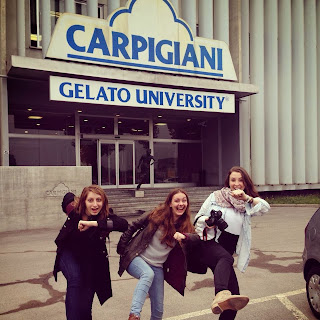
The inside looked much more like how you'd imagine a gelato museum, with brightly coloured decor (the round seats looked almost like scoops of ice cream), a video telling the story of the gelato (you can see it here if you're keen) and a gift shop selling ice cream-shaped everything. When you walk in, a glass wall allows you to watch the class of students hard at work perfecting their various ice cream concoctions while consulting complicated-looking ratios and equations scribbled on whiteboards around the room - apparently you really can get a degree in ice cream. Only in Italy.
Their courses are aimed at people who own a gelateria, but are open to anyone (I may need to consider a change of degree) and teach the art of ice cream-making in all its forms, from basic sorbets to artisan gelato, as well as the practicalities of running a business.
The actual museum is tacked on to the Gelato University. It's small, and a visit takes no more than an hour, during which our guide explained the yummy history of gelato. She focused mainly on how it is made; not only have recipes been refined somewhat since its humble beginnings as an Aztec treat made of snow and fruit juice, but the techniques used have become easier. Once upon a time, ice cream making required monstrous machines, 4-6 workers and constant stirring, but Carpigiani managed to scoop up profits with the invention of the electrical 'Autogelateria', soon becoming the world leader in ice cream machinery. Examples of their machines from past and present were on display, although some of the older ones looked better suited to illegal torture than creating gelato-y goodness.
It's well thought out in terms of display, with an array of photos, advertising campaigns and brightly coloured packaging from over the years alongside the tools of the trade to give you a taste of the dessert's history. It's a cute little museum, and entry is free, but to be honest in itself I'm not sure it would be worth the 40 minute bus ride from the centre.
Where it comes into its own however, and the real motivation for making the journey, is the variety of added experiences on offer, ranging from a simple ice cream tasting to a one-day crash course in making artisan ice cream. Having opted for the cheapest package - the tasting, at €5, we had expected to be given maybe a couple of spoonfuls of different ice creams. Instead, we were each treated to heaven in a cone; kingsize scoops of delicious freshly made gelato, in two flavours of our choice. Two months into living in Italy, and with the weather getting colder, you'd think I would have reached some kind of saturation point with gelato, but I never wanted that ice cream to end. It's official, Gelato University is the tastiest museum ever.
Stepping through the gates of the huge Carpigiani Gelato University, I felt very much like Charlie Bucket, but Willy Wonka's Chocolate Factory this was not. From the outside it could be any industrial factory; large, modern, and a not particularly pleasant off-white colour. When we reached the door, we were greeted by a statue of an Italian Olympic hurdler, mid-hurdle. A peculiar choice of mascot; the inscription insisted he was a symbol of 'enthusiasm of the future', but it looks more like he's running away from the museum... Not the most inviting of entrances, but then the allure of gelato was invitation enough, so in we went.

Their courses are aimed at people who own a gelateria, but are open to anyone (I may need to consider a change of degree) and teach the art of ice cream-making in all its forms, from basic sorbets to artisan gelato, as well as the practicalities of running a business.
The actual museum is tacked on to the Gelato University. It's small, and a visit takes no more than an hour, during which our guide explained the yummy history of gelato. She focused mainly on how it is made; not only have recipes been refined somewhat since its humble beginnings as an Aztec treat made of snow and fruit juice, but the techniques used have become easier. Once upon a time, ice cream making required monstrous machines, 4-6 workers and constant stirring, but Carpigiani managed to scoop up profits with the invention of the electrical 'Autogelateria', soon becoming the world leader in ice cream machinery. Examples of their machines from past and present were on display, although some of the older ones looked better suited to illegal torture than creating gelato-y goodness.
It's well thought out in terms of display, with an array of photos, advertising campaigns and brightly coloured packaging from over the years alongside the tools of the trade to give you a taste of the dessert's history. It's a cute little museum, and entry is free, but to be honest in itself I'm not sure it would be worth the 40 minute bus ride from the centre.
Where it comes into its own however, and the real motivation for making the journey, is the variety of added experiences on offer, ranging from a simple ice cream tasting to a one-day crash course in making artisan ice cream. Having opted for the cheapest package - the tasting, at €5, we had expected to be given maybe a couple of spoonfuls of different ice creams. Instead, we were each treated to heaven in a cone; kingsize scoops of delicious freshly made gelato, in two flavours of our choice. Two months into living in Italy, and with the weather getting colder, you'd think I would have reached some kind of saturation point with gelato, but I never wanted that ice cream to end. It's official, Gelato University is the tastiest museum ever.
Tuesday, 22 October 2013
A pilgrimage of sorts: Visiting Bologna's Sanctuary of the Madonna of San Luca
Approximately 300 metres above Bologna's centro storico, the Sanctuary of the Madonna of San Luca sits atop the Monte di Guardia, and it's a must see for anyone visiting Bologna - as long as you're up for a bit of a walk.
The first time I made the journey was on one of my first days here, when I naively joined what I thought would be a pleasant Erasmus outing. What better way to spend a sunny Sunday afternoon than a leisurely stroll and the chance to meet new people? Famous last words. The walk takes at least an hour, most of it uphill as you ascend the world's longest portico - 658 archways in all. Not ideal in searing heat and inappropriate footwear, and I soon fell to the back of the group along with a few others, although on the bright side we were able to bond over the inhumanity of it all.

Then there was a bit of an unfortunate moment when we were at the actual Sanctuary. Anxious to see if the church was worth the walk, we headed straight inside, and had somehow made it almost to the front when someone in distinctly priestlike attire started talking. "Nel nome del padre, del figlio e dello spirito santo..." Hang on, that sounds like - yep, we'd managed to gatecrash the Sunday service. Cue shifty exit from the church, and probable eternal damnation.
.JPG "sanctuary madonna san luca pilgrimage church bologna")
The church itself is huge and a bright orange colour, managing to be both beautiful and imposing. The reason it's a top destination for Catholic pilgrims is that it houses a Byzantine portrait of Madonna and child, supposedly painted by St Luke. The portico was built to shield the painting during its annual parade down to the city centre and then back up again - presumably this tradition is for the benefit of the lazier of the pilgrims.
.JPG)
The Sanctuary must have the world's most dedicated, not to mention fittest, congregation. But although I'm not religious, the views alone are worth the trek. You don't see much of the scenery until you reach the top as most views from the path are blocked by trees, plus I was slightly distracted by the searing September heat, and the aching of muscles I'd forgotten I had. So when you reach the summit and are greeted by miles of Emilia Romagna countryside spread out below, it certainly has an impact.
.JPG "sanctuary madonna san luca pilgrimage church bologna")
Pilgrimage number two took place whilst Jason was visiting, and the third was with some of my friends, including one from Bologna who had never done the trip. These visits were better timed, as we made it to the top just in time for the last of the sunlight, bathing the church in a warm glow. The 4km hike also felt noticeably easier the third time around, thankfully, though I'm a little way off using it as a running track like many of the nutty locals. Being overtaken by a lycra-clad pensioner zooming past has become a more common occurrence than I'd care to admit.
There's a superstition amongst Bologna students that walking up to the Sanctuary brings you good luck in exams, so if they're to be believed I must be on for a first... If nothing else, at this rate I'm going to have thighs of steel by the end of my time here, definitely justification for the amount of food I'm eating.

The first time I made the journey was on one of my first days here, when I naively joined what I thought would be a pleasant Erasmus outing. What better way to spend a sunny Sunday afternoon than a leisurely stroll and the chance to meet new people? Famous last words. The walk takes at least an hour, most of it uphill as you ascend the world's longest portico - 658 archways in all. Not ideal in searing heat and inappropriate footwear, and I soon fell to the back of the group along with a few others, although on the bright side we were able to bond over the inhumanity of it all.

Then there was a bit of an unfortunate moment when we were at the actual Sanctuary. Anxious to see if the church was worth the walk, we headed straight inside, and had somehow made it almost to the front when someone in distinctly priestlike attire started talking. "Nel nome del padre, del figlio e dello spirito santo..." Hang on, that sounds like - yep, we'd managed to gatecrash the Sunday service. Cue shifty exit from the church, and probable eternal damnation.
.JPG "sanctuary madonna san luca pilgrimage church bologna")
The church itself is huge and a bright orange colour, managing to be both beautiful and imposing. The reason it's a top destination for Catholic pilgrims is that it houses a Byzantine portrait of Madonna and child, supposedly painted by St Luke. The portico was built to shield the painting during its annual parade down to the city centre and then back up again - presumably this tradition is for the benefit of the lazier of the pilgrims.
.JPG)
The Sanctuary must have the world's most dedicated, not to mention fittest, congregation. But although I'm not religious, the views alone are worth the trek. You don't see much of the scenery until you reach the top as most views from the path are blocked by trees, plus I was slightly distracted by the searing September heat, and the aching of muscles I'd forgotten I had. So when you reach the summit and are greeted by miles of Emilia Romagna countryside spread out below, it certainly has an impact.
.JPG "sanctuary madonna san luca pilgrimage church bologna")
Pilgrimage number two took place whilst Jason was visiting, and the third was with some of my friends, including one from Bologna who had never done the trip. These visits were better timed, as we made it to the top just in time for the last of the sunlight, bathing the church in a warm glow. The 4km hike also felt noticeably easier the third time around, thankfully, though I'm a little way off using it as a running track like many of the nutty locals. Being overtaken by a lycra-clad pensioner zooming past has become a more common occurrence than I'd care to admit.
There's a superstition amongst Bologna students that walking up to the Sanctuary brings you good luck in exams, so if they're to be believed I must be on for a first... If nothing else, at this rate I'm going to have thighs of steel by the end of my time here, definitely justification for the amount of food I'm eating.

Sunday, 20 October 2013
Lo sciopero: My first Italian strike
When I signed up for five months of Italian culture, I admit I was focusing on the pasta-eating, siesta-loving side of things, rather than the levels of bureaucracy and probable corruption that turn the simplest admin task into an obstacle course. And not a fun obstacle course like on 50:50 or Jungle Run. An obstacle course involving hours of queuing, being sent to a different person/building/city by everyone you meet, and, when you finally find the person who can supposedly help you, you discover they're on their 3-hour lunch break, or that their office is only open from 7:12-9:53 every second Tuesday of the month and only if there's a full moon. Another intregal part of the not-so-dolce vita is coping with the infamous Italian strikes, and this weekend I got to experience my very first sciopero, as a general strike descended over Italy.
The main problem for me was the public transport strike, as I live a 50 minute walk out of the city centre. This is usually no problem for me as having lived in a tiny Cheshire village miles from civilisation for all my life, I'm a bit of a public transport pro - should you ever need expert advice on the cheapest tickets, timetables, or life stories of assorted Warrington bus drivers, I'd be happy to oblige. And I'm proud to now add to this exciting repertoire of specialist subjects: Public Transport in Northern Italy.
Against all expectations and accepted stereotypes, I've hardly had any problems so far with Bologna's buses. My bus stop is nice and near and my bus is frequent, takes the quickest route to the centre, and runs until 1am. The trains are a different story. Although Bologna has one of the main stations in Italy and it is in theory easy to get around, delays are common and a favourite pastime of whichever jokers do the announcements is to change the platform of your train approximately one minute before its scheduled departure. Cue a mass exodus of everyone on what you had all foolishly presumed to be your train (based on the fact that, um, it said it was going to your destination), which is now heading somewhere entirely undesirable.
You then have to fight your way to the new platform - this can involve just standing in the midst of a crowd of seasoned Italian travellers and hoping you get swept along in the right direction. My worst experience so far was getting the train to Riccione for a day at the beach, which underwent a total of three platform changes.
Whilst running around the station (I'm 99% certain of all the station staff group together at this point watching the CCTV screens, cackling as they observe the chaos they have created), we were simultaneously trying to communicate each update to Tom, who, alongside a disturbing tendency to start all discussions about future plans with the phrase "When I run my own dictatorship..." had already taken on the role of 'the late friend'. We finally made it on to the right train in true dramatic fashion, just as the doors were about to close.
But back to the buses. As luck would have it, my bus to work was for some reason not taking part in the strike, arriving if anything more punctually than usual. I arrived at work only to find out the strike had sent the office into an even more chaotic state than usual as no one knew what was going on, and after an unproductive morning I resigned myself to the long walk home.
By law there has to be a creepy-sounding 'skeleton schedule' or reduced service during strikes, and for reasons best known to themselves, the strikers took a break from half 4 to half 7 anyway, when normal service was resumed so that people could get home from work without disruption. I'm not convinced the Italians have understood the general concept of a strike to be honest. But any and all buses going in the direction of my house were conspicuously absent, and none went by during my walk so I'm glad I didn't hang around waiting for it. My Italian friends were quick to point out the bright side of all this palava - "at least now you are experiencing real Italian life!", but somehow this wasn't a huge comfort. Why can't I just eat my bodyweight in gelato instead? Not fair.
The main problem for me was the public transport strike, as I live a 50 minute walk out of the city centre. This is usually no problem for me as having lived in a tiny Cheshire village miles from civilisation for all my life, I'm a bit of a public transport pro - should you ever need expert advice on the cheapest tickets, timetables, or life stories of assorted Warrington bus drivers, I'd be happy to oblige. And I'm proud to now add to this exciting repertoire of specialist subjects: Public Transport in Northern Italy.
Against all expectations and accepted stereotypes, I've hardly had any problems so far with Bologna's buses. My bus stop is nice and near and my bus is frequent, takes the quickest route to the centre, and runs until 1am. The trains are a different story. Although Bologna has one of the main stations in Italy and it is in theory easy to get around, delays are common and a favourite pastime of whichever jokers do the announcements is to change the platform of your train approximately one minute before its scheduled departure. Cue a mass exodus of everyone on what you had all foolishly presumed to be your train (based on the fact that, um, it said it was going to your destination), which is now heading somewhere entirely undesirable.
You then have to fight your way to the new platform - this can involve just standing in the midst of a crowd of seasoned Italian travellers and hoping you get swept along in the right direction. My worst experience so far was getting the train to Riccione for a day at the beach, which underwent a total of three platform changes.
Whilst running around the station (I'm 99% certain of all the station staff group together at this point watching the CCTV screens, cackling as they observe the chaos they have created), we were simultaneously trying to communicate each update to Tom, who, alongside a disturbing tendency to start all discussions about future plans with the phrase "When I run my own dictatorship..." had already taken on the role of 'the late friend'. We finally made it on to the right train in true dramatic fashion, just as the doors were about to close.
But back to the buses. As luck would have it, my bus to work was for some reason not taking part in the strike, arriving if anything more punctually than usual. I arrived at work only to find out the strike had sent the office into an even more chaotic state than usual as no one knew what was going on, and after an unproductive morning I resigned myself to the long walk home.
By law there has to be a creepy-sounding 'skeleton schedule' or reduced service during strikes, and for reasons best known to themselves, the strikers took a break from half 4 to half 7 anyway, when normal service was resumed so that people could get home from work without disruption. I'm not convinced the Italians have understood the general concept of a strike to be honest. But any and all buses going in the direction of my house were conspicuously absent, and none went by during my walk so I'm glad I didn't hang around waiting for it. My Italian friends were quick to point out the bright side of all this palava - "at least now you are experiencing real Italian life!", but somehow this wasn't a huge comfort. Why can't I just eat my bodyweight in gelato instead? Not fair.
Rimini and San Marino in photos
Anyone who knows me is probably familiar with my slight obsession with castles. I love visiting castles, I want to live in a castle, when I'm older I want to be a castle. As such, I took a few too many photos of San Marino's pièce de resistance, and thought they deserved their own blog post, along with Rimini's Roman ruins.
 |
| View from Ponte di Tiberio, Rimini |
 |
| Arco di Augusto, Rimini |
 |
| Ponte di Tiberio, Rimini |
 |
| A street in Rimini with Balamory-style pastel-coloured houses, all covered in amazing chalk(?) art |
 |
| The main government building in San Marino |
 |
| View from the climb to the top of San Marino city |


 |
| Entrance to the tower |
 |
| The first tower |
 |
| At the top of the tower |
 |
 |
| View of the second tower from the first |


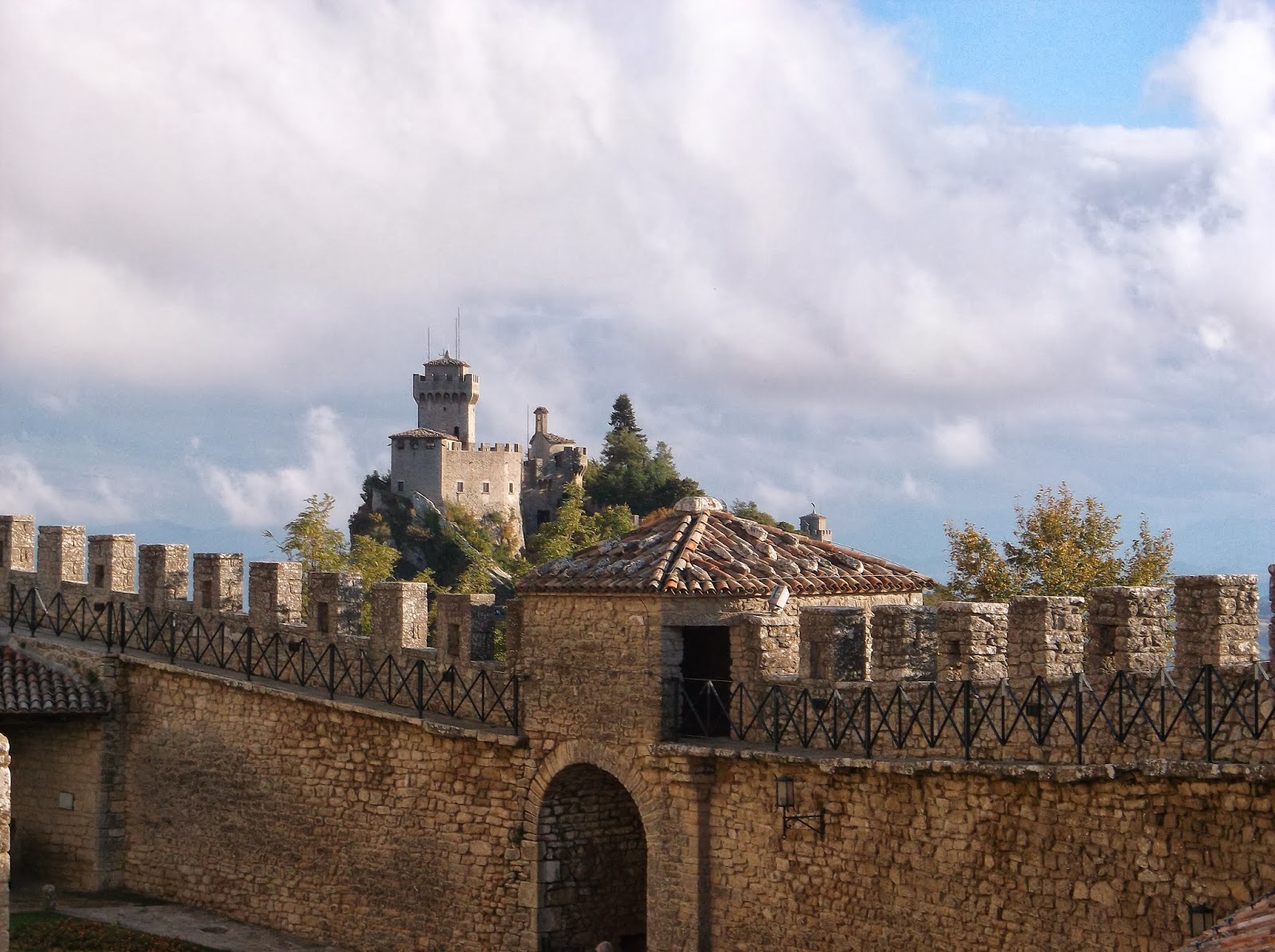

I like the Narnia-style lamppost in the last picture because in some ways San Marino reminded me of a real life Narnia (which was actually named after an Italian town). It's difficult to reach, with the lack of train station meaning you either have to drive or get a bus from an Italian city, usually Rimini, and once you get past the touristy restaurants and gift shops and arrive at the towers, it feels like you've stepped out of Italy and arrived in a different world.
Obviously it is a country unto itself, but that's not it. San Marino is by no means backward, with one of the most stable economies and highest GDP per capita in the world today, a university, football team, and unusually high life expectancy for its population. All the same, it's hard to reconcile its status as a modern European state with the fairytale images of the castle and sprawling postcard perfect landscapes, which help it retain something of a peaceful, medieval atmosphere.
Friday, 18 October 2013
Rimini and San Marino
Almost none of the locals stay in Bologna during the summer, instead choosing to flee the heat and humidity and head to the coast at August. Rimini is a popular choice with nearly everyone I've met here; it's Italy's answer to Ibiza with sandy beaches and nightlife galore, and last Saturday we arrived at this same beachfront, one of Europe's longest, lined with identikit hotels and bars. What with it being October and freezing cold, these were all closed, and the marina had become a ghost town - save for one mental Italian woman enjoying a sub-zero swim. Instead, we headed towards the lesser-frequented city centre. It's home to several Roman monuments, the most famous being the Arco di Augusto and the Ponte di Tiberio, both of which were suitably impressive if you're into that sort of thing, but out of season it's not the most exciting of visits.
The main reason we went was actually as a stop en route to the nearby country of San Marino, and after a couple of hours wandering round Rimini, we hopped back into the coach to continue the journey. Although geographically slap bang in the middle of Italy, The Most Serene Republic of San Marino isn't part of the EU and has its own government - not to mention a fairly sizeable army, made up of 1 in every 60 of its population.
There was one slight glitch; despite San Marino's USP being its status as a microstate, all three of us Brits on the coach had managed to forget our passports. Our fears were confirmed when the guy leading the trip made an announcement, reminding us that San Marino was a separate state, and you need ID documents to enter... he added cheerfully that it had all been written in the email, but that every year several students forget so we wouldn't be alone if we were left to wait on the bus. Err, brilliant. We consoled ourselves with the thought that getting refused entry to a country was a 'great story', but the prospect of going all that way just to sit forlornly on the coach all afternoon was just a bit too tragic.
As it turned out, all was OK. The Erasmus guy casually informed us ten minutes later that the announcement about ID was a 'scherzo', casting a little smirk in our flustered, and now rather embarrassed, direction. And who said the Italians can't do banter. Still, I was less than impressed that he made me doubt my email reading skills.
It was a good job we were allowed into San Marino though, as it was a much more memorable visit than Rimini. The third smallest state in Europe and, so it claims, the world's oldest republic, San Marino is made up of several towns, with its hilltop capital, City (and they're using that word in its broadest, or rather tiniest, sense) of San Marino as its crowning glory.
The highlight is the castle, made up of three tower fortresses perched atop Mount Titano. Each tower clings to the cliffedge, looking impressive and mystical surrounded by clouds as they overlook the rest of Italy.
San Marino seemed very tourist orientated, and gift shop after gift shop lined the steep walk up to the towers, selling everything from San Marino snow globes to phallic bottles of limoncello. It also boasts a fair few museums for its tiny size; we passed the Museum of Modern Weapons, Museum of Ancient Weapons, Museum of Torture, Museum of Instruments of Torture...you can see a bit of a theme developing here.
Sadly, there wasn't time to broaden our knowledge of weapons and/or torture, as we spent our time there walking up to the first tower, which you can go inside and climb to the top of. It offers some of the best, most fairytale-esque views I've ever seen, both of the landscapes below and of its sister tower.
The main reason we went was actually as a stop en route to the nearby country of San Marino, and after a couple of hours wandering round Rimini, we hopped back into the coach to continue the journey. Although geographically slap bang in the middle of Italy, The Most Serene Republic of San Marino isn't part of the EU and has its own government - not to mention a fairly sizeable army, made up of 1 in every 60 of its population.
There was one slight glitch; despite San Marino's USP being its status as a microstate, all three of us Brits on the coach had managed to forget our passports. Our fears were confirmed when the guy leading the trip made an announcement, reminding us that San Marino was a separate state, and you need ID documents to enter... he added cheerfully that it had all been written in the email, but that every year several students forget so we wouldn't be alone if we were left to wait on the bus. Err, brilliant. We consoled ourselves with the thought that getting refused entry to a country was a 'great story', but the prospect of going all that way just to sit forlornly on the coach all afternoon was just a bit too tragic.
As it turned out, all was OK. The Erasmus guy casually informed us ten minutes later that the announcement about ID was a 'scherzo', casting a little smirk in our flustered, and now rather embarrassed, direction. And who said the Italians can't do banter. Still, I was less than impressed that he made me doubt my email reading skills.
It was a good job we were allowed into San Marino though, as it was a much more memorable visit than Rimini. The third smallest state in Europe and, so it claims, the world's oldest republic, San Marino is made up of several towns, with its hilltop capital, City (and they're using that word in its broadest, or rather tiniest, sense) of San Marino as its crowning glory.
The highlight is the castle, made up of three tower fortresses perched atop Mount Titano. Each tower clings to the cliffedge, looking impressive and mystical surrounded by clouds as they overlook the rest of Italy.
San Marino seemed very tourist orientated, and gift shop after gift shop lined the steep walk up to the towers, selling everything from San Marino snow globes to phallic bottles of limoncello. It also boasts a fair few museums for its tiny size; we passed the Museum of Modern Weapons, Museum of Ancient Weapons, Museum of Torture, Museum of Instruments of Torture...you can see a bit of a theme developing here.
Sadly, there wasn't time to broaden our knowledge of weapons and/or torture, as we spent our time there walking up to the first tower, which you can go inside and climb to the top of. It offers some of the best, most fairytale-esque views I've ever seen, both of the landscapes below and of its sister tower.
Monday, 14 October 2013
Day trips from Bologna: Ferrara, Modena, Ravenna
Usually my days here are filled with a combination of work at the Goethe Zentrum, inflicting my shockingly bad accent on new Italian besties in the hopes of one day becoming fluent, and being a bit of a tourist with fellow year abroaders. But while Jason was visiting, the first two activities were off the agenda as he doesn't speak Italian. So after I'd shown him round Bologna, introduced him to my other English friends and initiated him into the art of the apperitivo (my main tips being to sit near the food table so as to get first pickings when a new tray of treats is served, and not feel any shame in refilling your plate over and over), we decided to venture further afield. Bologna is well placed for getting around the rest of Italy, and Ferrara was our first port of call, followed by Ravenna, and finally a rainy Monday in Modena.
Ferrara was our favourite of the three, largely down to the impressive d'Este castle, which comes complete with moat, drawbridge and dungeons where you can still see the graffiti carved by 16th century prisoners. We also saw the synagogue and former Jewish ghetto; the city has always had a strong Jewish presence and is the setting for one of the books I'm studying at the moment, Il Giardino dei Finzi-Contini. The garden itself is fictional, but it was interesting to see some of the other locations from the novel, although these represent a more sombre part of Ferrara's history. Today, the pace of life there seems quite chilled out; known as the 'city of bicycles', the sound of their wheels over the cobblestone streets made a welcome change from the whirring motorbikes which terrify me in Bologna.


Ravenna is famous for the mosaics which adorn its churches. They are so intricately detailed that it's hard to imagine the effort and time that must have gone into creating them, but on a less intellectual note, I liked how brightly coloured and shiny they were, barely having faded over the thousands of years. One of the chapels is decorated with hundreds of mosaic birds, a nice contrast to the depressing frescoes of Judgement Day which you normally see in churches. We were also able to visit the tomb of Dante, meaning I can definitely justify the trip as 'educational'. He died in Ravenna where he had sought political refuge, though apparently the Florentines are still trying to gain custody of his remains, which I think is a bit rich having exiled him in the first place.

Meanwhile in Modena, the compact city centre was just the right size for an afternoon trip. The Ghirlandina tower and cathedral in the central square are its most notable sights, and were impressive even in the pouring rain. In fact, the whole town is very picturesque; like Bologna, its streets are full of pretty red and orange buildings and grand palazzos. One of these is now a training academy for the Italian military, and as we sheltered from the rain we could see them begin their drills.


Every time I visit a new city, I can't help imagining what my year abroad might have been like if I'd gone there instead. Ferrara, Modena and Ravenna all made good day trip destinations, but for me Bologna is the clear winner. They probably all have more to offer the longer you stay there, and the rain may have had something to do with it, but none of them quite matched Bologna's atmosphere or activity, and it was always comforting to return to its busy city centre in the evening - scary motorcyclists and all.
Ferrara was our favourite of the three, largely down to the impressive d'Este castle, which comes complete with moat, drawbridge and dungeons where you can still see the graffiti carved by 16th century prisoners. We also saw the synagogue and former Jewish ghetto; the city has always had a strong Jewish presence and is the setting for one of the books I'm studying at the moment, Il Giardino dei Finzi-Contini. The garden itself is fictional, but it was interesting to see some of the other locations from the novel, although these represent a more sombre part of Ferrara's history. Today, the pace of life there seems quite chilled out; known as the 'city of bicycles', the sound of their wheels over the cobblestone streets made a welcome change from the whirring motorbikes which terrify me in Bologna.


Ravenna is famous for the mosaics which adorn its churches. They are so intricately detailed that it's hard to imagine the effort and time that must have gone into creating them, but on a less intellectual note, I liked how brightly coloured and shiny they were, barely having faded over the thousands of years. One of the chapels is decorated with hundreds of mosaic birds, a nice contrast to the depressing frescoes of Judgement Day which you normally see in churches. We were also able to visit the tomb of Dante, meaning I can definitely justify the trip as 'educational'. He died in Ravenna where he had sought political refuge, though apparently the Florentines are still trying to gain custody of his remains, which I think is a bit rich having exiled him in the first place.


Every time I visit a new city, I can't help imagining what my year abroad might have been like if I'd gone there instead. Ferrara, Modena and Ravenna all made good day trip destinations, but for me Bologna is the clear winner. They probably all have more to offer the longer you stay there, and the rain may have had something to do with it, but none of them quite matched Bologna's atmosphere or activity, and it was always comforting to return to its busy city centre in the evening - scary motorcyclists and all.
Subscribe to:
Posts (Atom)